How the Patent Office Learned to Stop Worrying and Love Junk Patents
Alex Moss | August 19, 2026
The word “inventor” used to mean something: a pioneer in a workshop, sweating through trial and error to bring something genuinely new into the world. The U.S. Patent and Trademark Office—the very agency charged with protecting invention—is making sure that isn’t what it means anymore.
The agency recently unveiled a brand-new official “Innovator Trading Card” featuring none other than U.S. Commerce Secretary Howard Lutnick—the cabinet official who oversees it. Minting a cabinet official into a collectible like a baseball star lays bare how low the USPTO’s standards for an “invention” have sunk.
But you don't have to take our word for it. Look at one of the patents issued directly to Lutnick by the very office he oversees.
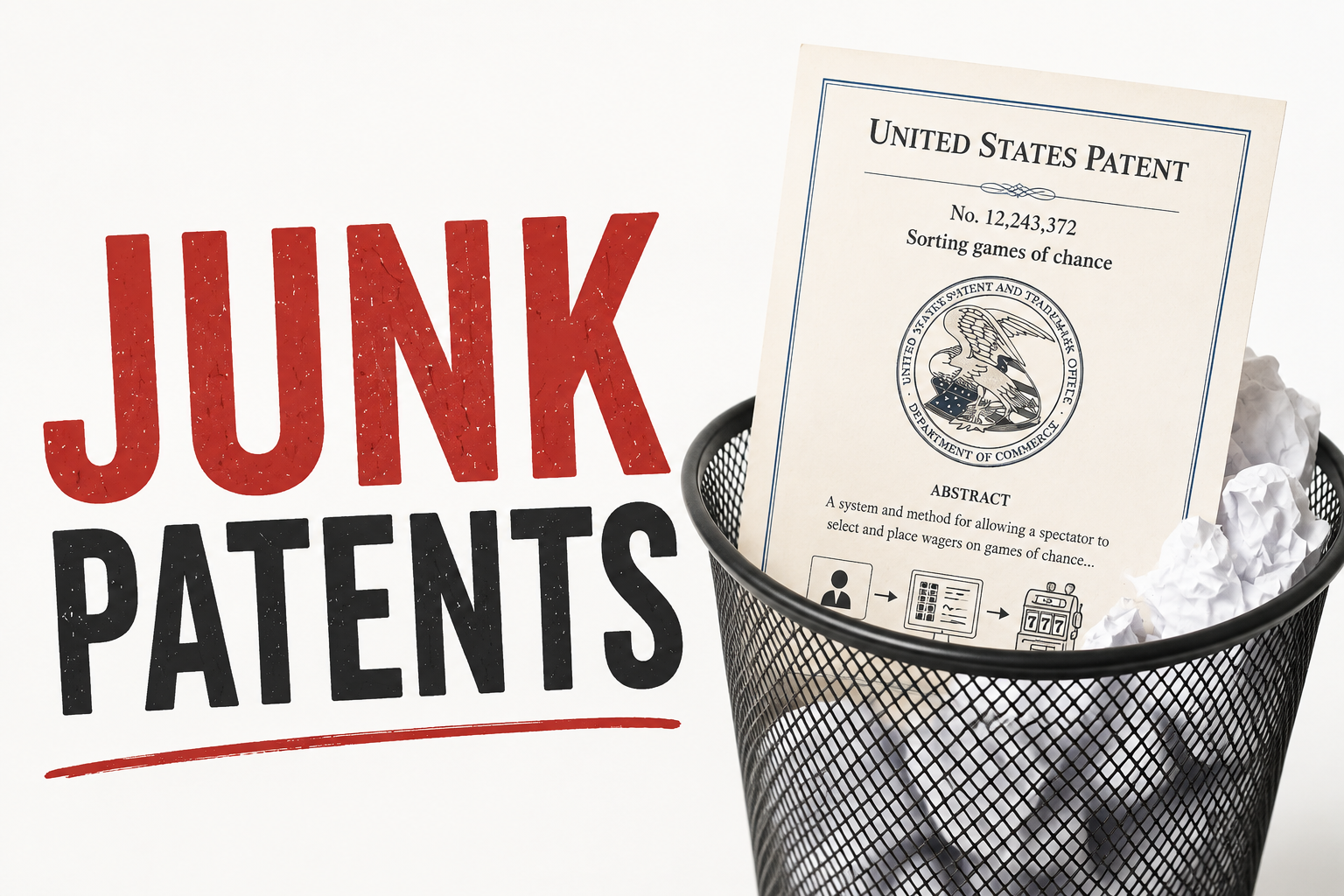
“Sorting Games of Chance”: Junk Patent Issued by and to Lutnick
U.S. Patent No. 12,243,372, titled “Sorting games of chance,” was granted to “inventors” Howard Lutnick, Dean Alderucci, and Geoffrey Gelman on March 4, 2025. It claims exclusive rights to sorting through a list of active casino games to decide which to watch or bet on. That’s the core invention: selecting a game from a list to bet on.
The patent traces back through a chain of continuations to an application first filed on April 5, 2007. The application that became this patent was filed in July 2022—fifteen years later—and finally issued in 2025. This continuation strategy is a classic play: file broadly, keep the family tree alive indefinitely, tweak claims, and wait for an examiner to yield. It’s the same tactic pharmaceutical companies use to “evergreen” their monopolies, inflating drug prices long beyond any single patent’s term.
What Lutnick’s Patent Claims
The patent covers a computer system that lets a spectator sort through a list of active casino games to decide which one to watch or bet on. Here is the core claim, simplified:
Receive criteria for selecting a game
Find a game matching that criteria
Calculate betting odds
Show the odds alongside a live video feed
Receive the spectator’s bet
Wait for the outcome
Pay out (or not) based on the outcome
That's it. A computer that lets you bet on someone else's game.
None of the patent’s claims offer anything remotely inventive. Claim 3 says the selection criterion could be that the primary player has the “highest net winnings of any primary player over a particular period of time.” Claim 7: the player “has won the last five games that he has played.” Claim 14 includes presenting “an image that includes a visual representation... including a first arrow pointing from the remote computing device.”
Find the hot player. Show who’s winning. Draw an arrow. These are not inventions.
The Patent’s Own Words
The patent runs over 100 pages, much of it devoted to defining everyday objects with legalistic absurdity. Here is how the patent explains what a display is:
“Display screens may include cathode ray tubes, flat panel displays, plasma displays, liquid crystal displays, diode displays, light-emitting diode displays, . . . holographic displays, and so on.”
A display screen is a display. Any kind of display. The patent solemnly informs the USPTO of this.
Here is the patent explaining how sorting works:
“In some embodiments, a player may search for a game with a particular value or a particular instance of any associated type of data. For example, a player may search for a game played at a particular time, for a game played by a particular player, for a gaming table with a highly rated dealer, for a gaming device located in a particular area of a casino, and/or for any other particular characteristic.”
A player may search for a game based on time, player, location—any associated data at all. This is basic database querying that Microsoft Excel has offered since 1985.
If there were any doubt that the patent envisions standard database technology, it makes that clear: “In various embodiments, a secondary player may view data related to a game, gaming device, primary player, game table, dealer, or other entity or device related to gaming using a tabular format. Each line in a table may contain related data, such as data all describing the same game or the same gaming device.”
Tabular data. Rows in a table. The patent takes standard database searching, attaches the words “gaming device,” and claims it as a proprietary technical advance.
What about the “secondary player”? The patent explains that “As used herein, ‘secondary player’, ‘secondary players’, and the like, may refer to a player or players who participate or may come to participate in games played by primary players or by other secondary players.”
In other words, secondary player means “another player.”
This is not an inventor describing a technical solution or advance. This is the language of a patent drafted to be long and cumbersome—to exhaust a patent examiner reviewing it and hide the fact that there’s no invention anywhere in sight.
The Pattern: Patent System Failure
This is not an isolated filing. Lutnick has over 500 granted patents. A district court refused to enforce one because the inventors submitted false statements with the intent to deceive the USPTO—a ruling upheld on appeal. Now, as Commerce Secretary, Lutnick is making it easier than ever for himself and others like him to drain resources from productive companies—those that actually make and sell things people need—and harder than ever for real inventors to stand out and succeed.
When the government grants low quality patents, the patent system fails to do what the Constitution mandates—promote the progress of science and useful arts. Junk patents create uncertainty for legitimate inventors. They are used to bully companies into settling for outsize sums, forcing them to fire employees, raise prices, or close altogether. No other country in the world grants as many junk utility patents as the United States. Our absurd continuation system and de minimis examination standards are outliers—directly tied to our globe-leading rates of patent litigation and drug prices.
The Patent Office was created to protect and promote invention. Today it does the opposite: it grants junk patents, promotes profiteering, and forgets what the word “inventor” even means.